ORIGAMI SIMULATOR
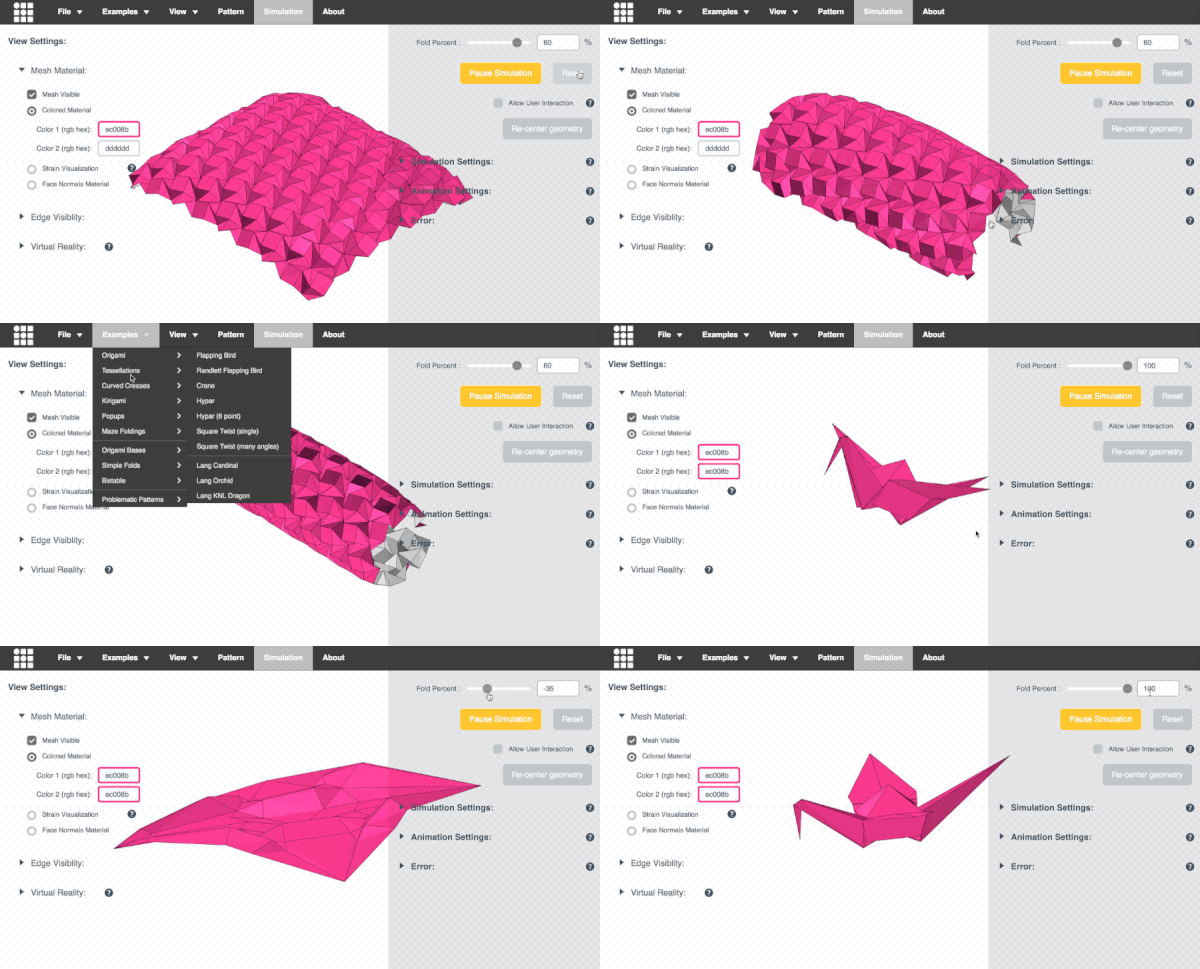
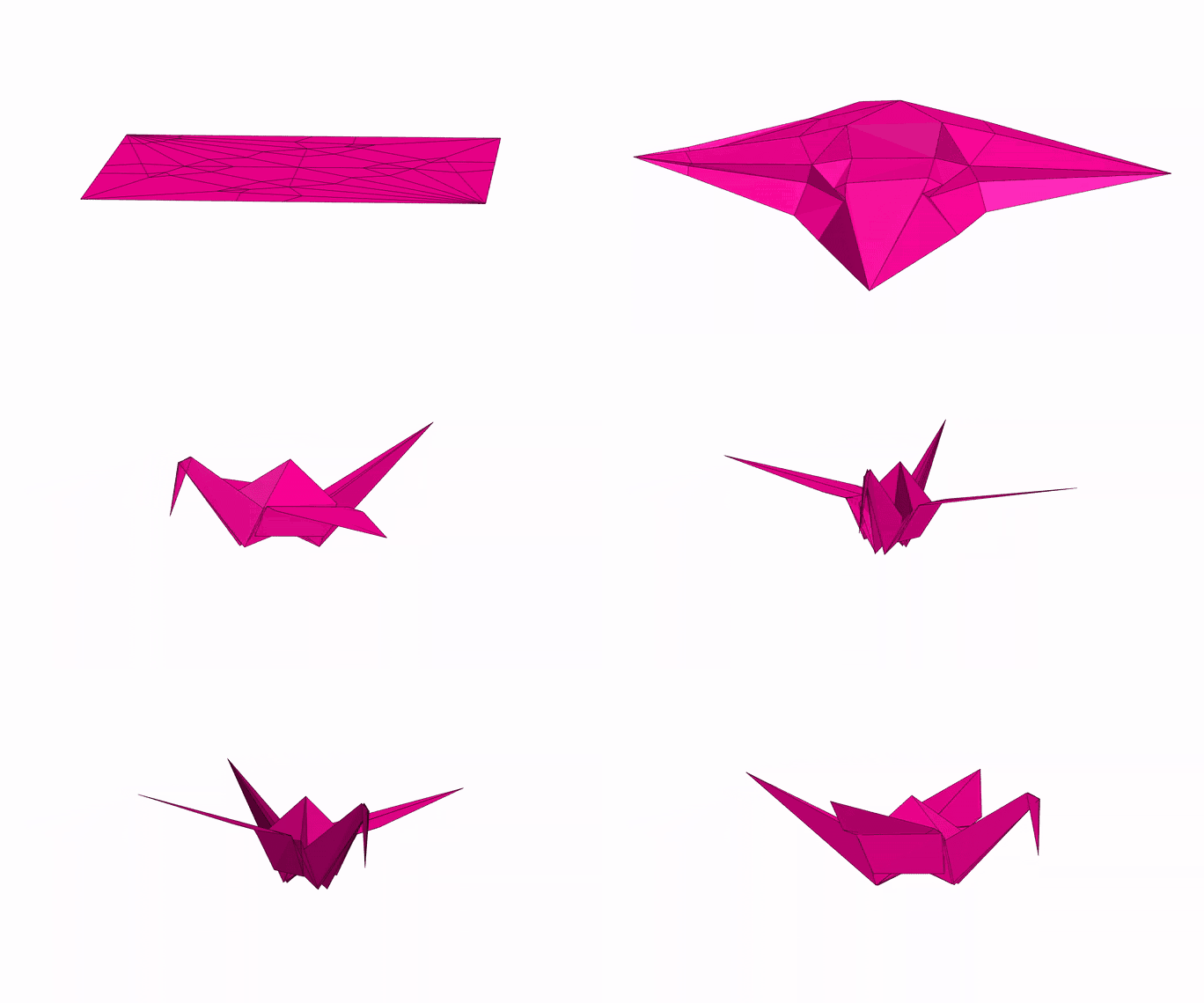
This app allows you to simulate how any origami crease pattern will fold. It may look a little different
from what you typically think of as "origami" - rather than folding paper in a set of sequential steps,
this simulation attempts to fold every crease simultaneously. It does this by iteratively solving for small displacements in the geometry of an initially flat sheet due to forces
exerted by creases.
You can read more about it in our paper:
This app also uses the methods described in Simple Simulation of Curved Folds Based on Ruling-aware Triangulation to import curved crease patterns and pre-process them in a way that realistically simulates the bending between the creases. OnlyFans 21 04 21 Lily Kawaii JadeTeen Outdoor
Originally built by Amanda Ghassaei as a final project for Geometric Folding Algorithms.
Other contributors include Sasaki Kosuke, Erik Demaine, and others.
Code available on Github. If you have interesting crease patterns that would
make good demo files, please send them to me (Amanda) so I can add them to the Examples menu. My email address is on my website. Thanks!
In the vast and ever-evolving world of online


You can find additional information in our 7OSME paper and project website.
If you have feedback about features you want to see in this app, please see this thread.
Her personal story of how she entered the

In the vast and ever-evolving world of online content creation, specific keywords often serve as windows into particular niches, trends, and personas. The search query "OnlyFans 21 04 21 Lily Kawaii JadeTeen Outdoor" is a fascinating example, combining elements of a specific date, notable creators, and a popular content genre. This article will break down each component, exploring the rise of OnlyFans as a platform, the individual stories of creators Lily Kawaii and JadeTeen, and the growing phenomenon of outdoor content on the platform.
Her personal story of how she entered the industry is notable for its honesty. In a Q&A, she revealed, "To be completely honest, I had an ex boyfriend talk me into camming... I took control of the situation and he’s been out of my life for years. It isn’t the best way to have gotten into it, but I’m being honest. I am very happy doing it now though".
: In early 2025, JadeTeen gained significant attention for a viral claim—later suspected by some to be a hoax or scripted act —that she and her mother, Dani (known as Dani Swings), were impregnated by YouTuber Nick Yardy within two weeks of each other.
Creators must strategically command their own search engine optimization (SEO) keywords. By publishing official blogs, participating in interviews, and consistently updating verified links, models can push unauthorized or malicious third-party aggregators further down the search results.
The mention of "JadeTeen" in relation to Lily Kawaii often highlights the longevity of her presence online. In the fast-moving world of adult content, staying relevant for several years is a feat. By rebranding and evolving her look, Lily has managed to retain "legacy" fans from her JadeTeen days while attracting a new generation of subscribers who follow her for her updated, polished "Lily Kawaii" persona. Business Challenges and Longevity
Lily Kawaii and are two prominent OnlyFans creators who have built distinct careers through social media savvy and controversial viral marketing. While they operate in similar digital spaces, their career trajectories and content styles differ significantly. Lily Kawaii: Digital Presence and Content Style
Digital creators often adopt specific visual themes, such as the "kawaii" or "soft-girl" aesthetic, to differentiate their brand. This style focuses on a curated look that emphasizes specific color palettes and fashion choices. When moved to outdoor settings, this aesthetic utilizes natural lighting and scenic backdrops to enhance the visual appeal of the photography.
JadeTeen is a social media personality and viral adult content creator known for her rapid rise to financial success.
OnlyFans operates on a subscription model. Creators set a monthly fee (typically between $5 and $50), and fans pay to unlock their exclusive content. The platform takes a 20% commission on all payments, meaning creators keep 80% of their earnings. In 2021 alone, creators earned nearly $4 billion through the platform.
Creators control monthly subscription fees, pay-per-view (PPV) messaging prices, and tipping thresholds.
The digital footprints of creators like Lily Kawaii and JadeTeen illustrate how modern adult entertainment relies heavily on personal branding, subculture appeal, and meticulous multi-platform marketing. By treating their channels as structured digital businesses, independent models have successfully shifted the balance of power in the entertainment industry, commanding total control over their creative output, personal schedules, and financial destinies.
However, JadeTeen's presence in the public eye extends far beyond typical modeling content. She shot to mainstream infamy in March 2025 with a shocking and widely publicized claim. According to reports, JadeTeen (who goes by the online handle Jade) and her mother, Dani, both announced they were . The story, which was initially presented as real, quickly became a viral sensation, sparking intense debate and speculation across social media. The media widely reported on the jaw-dropping nature of the claim, with outlets like E! Online and Hindustan Times covering the story.
VIRTUAL REALITY
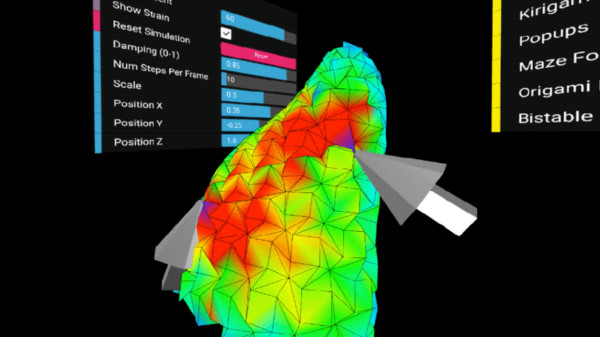
This tool currently supports an interactive Virtual Reality mode for the Vive and Oculus headset and controllers (it may work on others, but it is not tested).
For this to work, you must first use a WebVR enabled browser:
currently only an experimental build of Chromium (with enable-webvr and
-enable-gamepad-extensions flags) and the latest Firefox for Windows
are supported by this app.
When you open this page with the appropriate browser, you will see a button that says "ENTER VR". Clicking this will
put the app into an interactive VR mode. The hand controllers will allow you to grab the origami mesh and pull on it.
This is especially interesting if you set the Mesh Material to Strain Visualization so you can see how your interactions
change the internal strains in the material.
Troubleshooting:
ANIMATION SETTINGS
The dynamic simulation is calculated by solving for all the forces in the system, moving time forward in small Δt steps,
and updating the vertices of the origami incrementally. The time step size for this animation is calculated automatically
based on the material stiffnesses set in the Simulation Settings section: more stiff settings
require shorter time steps to solve and will slow down the simulation.
Num simulation steps per frame allows you to control the number of tiny time steps forward to take on each
render cycle. If the simulation looks choppy to you, you might consider lowering this setting.
Lowering the number of steps per frame will slow down the simulation, but will result in a more smooth animation.
SIMULATION ERROR
Average vertex error gives a sense of how much the distance constraints in the
origami pattern are being violated (i.e. how much the sheet is being stretched). The error at each vertex is evaluated by averaging the
percent deviation of all its distance constraints with adjacent vertices. This error is
reported as a percent of the total length of the distance constraint to remove scaling effects.
This measurement is equivalent to
Cauchy strain or engineering strain of the distance constraints on this system.
Increasing the Axial Stiffness will tighten these constraints and
lower the error in the simulation.
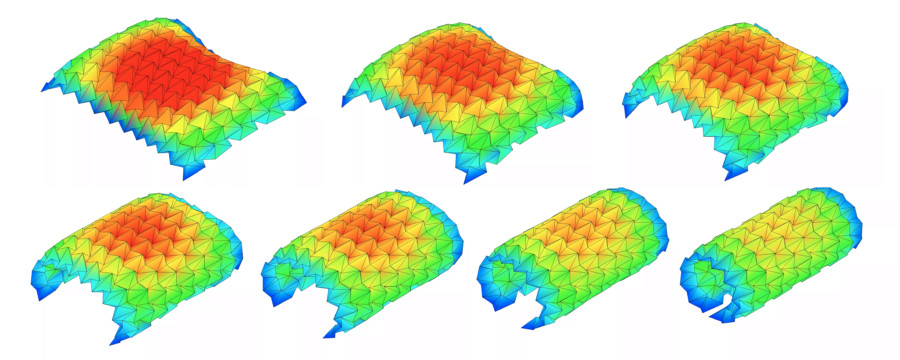
To visualize the error of each vertex graphically, select Strain Visualization under Mesh Material
in the left menu.
SIMULATION SETTINGS
This app uses a compliant dynamic simulation method to solve for the geometry of an origami pattern
at a given fold angle. The simulation sets up several types of constraints: distance constraints prevent the
sheet from stretching or compressing, face constraints prevent the sheet from shearing, and angular constraints fold or flatten the sheet. Each of these constraints is weighted by a stiffness - the stiffer the constraint, the better it is enforced
in the simulation.
Axial Stiffness is the stiffness of the distance constraints. Increasing axial
stiffness will decrease the stretching/compression (strain) in the simulation, but it will also slow down the solver.
Face Stiffness is the stiffness of the face constraints, which help the axial constraints prevent deformation of the sheet's surface between the creases.
Fold and facet stiffnesses correspond to two types of angular constraints. Fold Stiffness is the stiffness of the mountain
and valley creases in the origami pattern. Facet Stiffness is the stiffness of the triangulated faces between
creases in the pattern. Increasing facet stiffness causes the faces between creases to stay very flat as the origami is folded.
As facet stiffness becomes very high, this simulation approaches a
rigid origami simulation, and models the behavior of a rigid material (such as metal) when folded.
Internally, constraint stiffnesses are scaled by the length of the edge associated with that constraint to determine its geometric stiffness. For Axial constaints, stiffness is
divided by length and for angular constraints, stiffness is multiplied by length.
Since this is a dynamic simulation, vertices of the origami move with some notion of acceleration and velocity. In order to
keep the system stable and help it converge to a static solution,
damping is applied to slow the motion of the vertices. The Damping slider allows you to control the amount of damping
present in the simulation. Decreasing damping makes the simulation more "springy".
It may be useful to temporarily turn down damping to help the simulation more quickly converge towards its static solution - especially
for patterns that take a long time to curl.
A Numerical Integration technique is used to integrate acceleration into velocity and position for each time step of the simulation.
Different integration techniques have different associated computational cost, error, and stability. This app allows you to choose
between two different integration techniques: Euler Integration
is the simplest type of numerical integration (first order) with large associated error, and
Verlet Integration is a second order integration technique
with lower error and better stability than Euler.
COMPLIANT DYNAMIC SIMULATION
....
COMPLIANT STATIC SIMULATION
....
RIGID STATIC SIMULATION
....
STRAIN VISUALIZATION
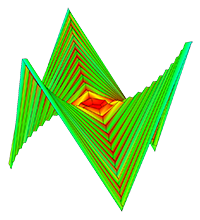
Cauchy strain or engineering strain is a unitless measurement of how much a material is being stretched or compressed under load.
The Strain Visualization illustrates the strain across an origami sheet by mapping it to a color from blue (no strain) to red (max strain).
USER INTERACTION
Toggle this control to enable/disable mouse interaction with the origami model. When enabled,
mousing over the model will display a highlighter; clicking and dragging allows you to
interact with the model in real time. Very vigorous interactions with the model may cause it
to pop into a strange configuration that it can't escape - use the Reset button to start
the simulation again from a flat state.
ROTATION SPEED
Speed : ( radians per frame )
BACKGROUND COLOR
Color (rgb hex) :
Hex colors are 6 digit alphanumeric codes that specify different colors. You can get these codes using a color picker.
SVG IMPORT SETTINGS
Vertex merge tolerance (px) :
For curved folding
Intervals of vertices for discretization (px) :
Approximation tolerance of curves (px) :
In the vast and ever-evolving world of online content creation, specific keywords often serve as windows into particular niches, trends, and personas. The search query "OnlyFans 21 04 21 Lily Kawaii JadeTeen Outdoor" is a fascinating example, combining elements of a specific date, notable creators, and a popular content genre. This article will break down each component, exploring the rise of OnlyFans as a platform, the individual stories of creators Lily Kawaii and JadeTeen, and the growing phenomenon of outdoor content on the platform.
Her personal story of how she entered the industry is notable for its honesty. In a Q&A, she revealed, "To be completely honest, I had an ex boyfriend talk me into camming... I took control of the situation and he’s been out of my life for years. It isn’t the best way to have gotten into it, but I’m being honest. I am very happy doing it now though".

: In early 2025, JadeTeen gained significant attention for a viral claim—later suspected by some to be a hoax or scripted act —that she and her mother, Dani (known as Dani Swings), were impregnated by YouTuber Nick Yardy within two weeks of each other.
Creators must strategically command their own search engine optimization (SEO) keywords. By publishing official blogs, participating in interviews, and consistently updating verified links, models can push unauthorized or malicious third-party aggregators further down the search results.
The mention of "JadeTeen" in relation to Lily Kawaii often highlights the longevity of her presence online. In the fast-moving world of adult content, staying relevant for several years is a feat. By rebranding and evolving her look, Lily has managed to retain "legacy" fans from her JadeTeen days while attracting a new generation of subscribers who follow her for her updated, polished "Lily Kawaii" persona. Business Challenges and Longevity
Lily Kawaii and are two prominent OnlyFans creators who have built distinct careers through social media savvy and controversial viral marketing. While they operate in similar digital spaces, their career trajectories and content styles differ significantly. Lily Kawaii: Digital Presence and Content Style
Digital creators often adopt specific visual themes, such as the "kawaii" or "soft-girl" aesthetic, to differentiate their brand. This style focuses on a curated look that emphasizes specific color palettes and fashion choices. When moved to outdoor settings, this aesthetic utilizes natural lighting and scenic backdrops to enhance the visual appeal of the photography.
JadeTeen is a social media personality and viral adult content creator known for her rapid rise to financial success.
OnlyFans operates on a subscription model. Creators set a monthly fee (typically between $5 and $50), and fans pay to unlock their exclusive content. The platform takes a 20% commission on all payments, meaning creators keep 80% of their earnings. In 2021 alone, creators earned nearly $4 billion through the platform.
Creators control monthly subscription fees, pay-per-view (PPV) messaging prices, and tipping thresholds.
The digital footprints of creators like Lily Kawaii and JadeTeen illustrate how modern adult entertainment relies heavily on personal branding, subculture appeal, and meticulous multi-platform marketing. By treating their channels as structured digital businesses, independent models have successfully shifted the balance of power in the entertainment industry, commanding total control over their creative output, personal schedules, and financial destinies.
However, JadeTeen's presence in the public eye extends far beyond typical modeling content. She shot to mainstream infamy in March 2025 with a shocking and widely publicized claim. According to reports, JadeTeen (who goes by the online handle Jade) and her mother, Dani, both announced they were . The story, which was initially presented as real, quickly became a viral sensation, sparking intense debate and speculation across social media. The media widely reported on the jaw-dropping nature of the claim, with outlets like E! Online and Hindustan Times covering the story.