
+2.5 Million
Active Science Users Worldwide

60%
Reduction in Laboratory Costs

80%
Improved Learning Retention Rate
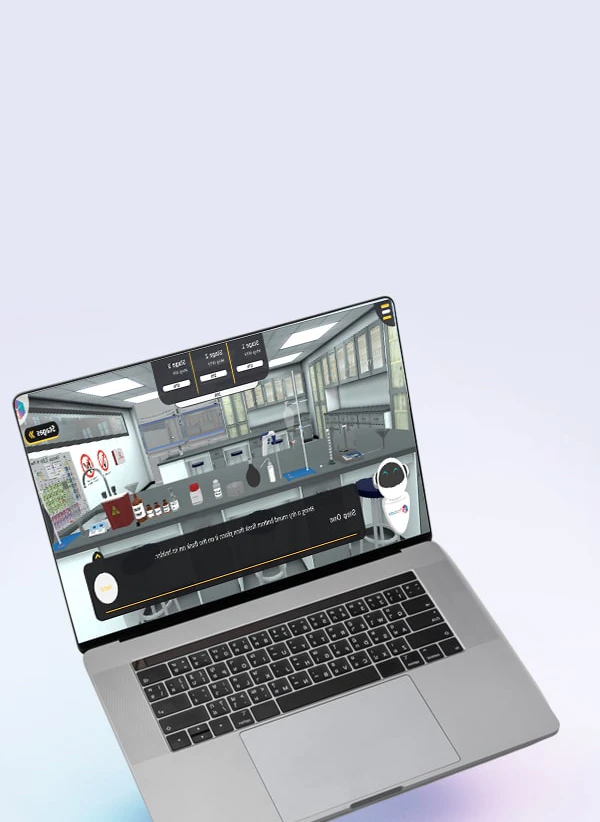
Curriculum-aligned 3D simulations for remote and on-campus learning—boost engagement, track progress, and improve outcomes while cutting costs and risks.
For universities and educational institutions
+2.5 Million
Active Science Users Worldwide
60%
Reduction in Laboratory Costs
80%
Improved Learning Retention Rate


Enhance student engagement and learning outcomes with gamified virtual lab simulation—featuring instant reporting, a built-in question bank, and seamless LMS integration

Give students hands-on science experiences in safe, realistic 3D environments—featuring game-like simulations that build real lab skills and meet curriculum needs. webx.series

Empower your students with real-time, personalized guidance —while you get actionable insights and content recommendations for every experiment "I loved the focus on AI this year,

Easily create quizzes with custom questions, types, difficulty, and timing. Link them to lab experiments, and let PraxiLabs handle instant grading and feedback control—all in one place. Most web3 projects rely on volatile governance tokens

Track every student’s actions and completions in real time, and access automated performance reports to support smarter teaching decisions.

Connect to Moodle, Canvas, Blackboard, and more—in just 24 hours, with zero IT hassle and no extra cost. Stay in control while saving your team time and resources.

Reach visual, auditory, and kinesthetic learners with multimedia content, voice guidance, and interactive simulations—all on one platform.

1
Create Free Account
Register in seconds—no hardware or credit card needed. Try 3 full simulations and explore core platform features.
2
Book Institutional Demo
Schedule a personalized walkthrough for your institution. Preview all features, ask questions, and request a custom quote.
3
Unlock the Right Plan
Pick the plan that fits your curriculum—access 210+ simulations or select a specific virtual science lab, plus quiz builder and LMS integration.

Didn't find the simulation you need? No problem! We’ll customize the experiment to fit your curriculum in any language (upon request).
Our dedicated training team is always available to help your institution’s staff unlock the full potential of our virtual lab features.

Our expert support team is available around the clock for troubleshooting, onboarding, or technical help. We're always here to guide you.
"I loved the focus on AI this year, but I wish there were more sessions on backend security." — CTO, [Company]
This WebX envisions a future where fairer economic models can flourish, and everyone can participate in the new digital economy.
Locking down the primary hook or thematic thread that links the episodes together.
Episodes explore developments in decentralized finance (DeFi), non-fungible tokens (NFTs), blockchain infrastructure, and regulatory structures within the Asian market.
Most web3 projects rely on volatile governance tokens. introduces a more stable model: "Series Credits" (SXC). SXC is a gas token pegged to the computational cost of rendering an XR frame. If a user spends 10 minutes in a high-fidelity VR space, they spend 0.1 SXC. Conversely, users who host edge nodes (sharing their GPU power to render scenes for others) earn SXC.
Managing data across different micro-frontends is notoriously difficult. Webx.series solves this with a lightweight, reactive state machine. It syncs state seamlessly between the server, the edge, and the client browser without boilerplate code. 3. Native AI Integrations
: A serialized video essay project by filmmaker Caveh Zahedi (featured on Just TV ) that documents the process of creating a web series. 3. Writing About Web Series
It interviews builders, developers, and founders across the decentralized tech sector.
The term "web series" traditionally defines a collection of structured, episodic videos distributed exclusively over the internet. Unlike legacy television networks, this format has democratized storytelling by lowering the barrier to entry for creators worldwide. Milestones in Online Episodic Media
In the professional technology space, "Webex series" usually refers to the Cisco Webex Room Series and Webex Desk Series. These are hardware solutions designed to enhance hybrid work environments through high-quality video conferencing and collaboration.
For software engineers and IT professionals, "WebX" frequently refers to a comprehensive educational trajectory mapping out the evolution of internet architecture. Educational programming resources—such as the Learn Code With Durgesh Frontend Series —frequently use variations of the WebX moniker to take learners from zero to hero in web architecture. Tracking the Evolution of Web Architectures
: Every episode features a different "X"—an unknown factor, from an AI that gained a soul to a ghost haunting a smart city’s power grid.
: Breaking down how traditional financial institutions deploy blockchain.

For universities and educational institutions

210+
Virtual Science Lab Simulations Available

20+
Science Branches Covered

11
Globally Recognized Awards in Science Education

160+
Countries around the globe

24/7
Tech Support Available Anytime

24
Hours to Set Up Free LMS Integration
Over 10 Global Awards for Advancing Science Education and Student Engagement
"I loved the focus on AI this year, but I wish there were more sessions on backend security." — CTO, [Company]
This WebX envisions a future where fairer economic models can flourish, and everyone can participate in the new digital economy.
Locking down the primary hook or thematic thread that links the episodes together.
Episodes explore developments in decentralized finance (DeFi), non-fungible tokens (NFTs), blockchain infrastructure, and regulatory structures within the Asian market.
Most web3 projects rely on volatile governance tokens. introduces a more stable model: "Series Credits" (SXC). SXC is a gas token pegged to the computational cost of rendering an XR frame. If a user spends 10 minutes in a high-fidelity VR space, they spend 0.1 SXC. Conversely, users who host edge nodes (sharing their GPU power to render scenes for others) earn SXC.
Managing data across different micro-frontends is notoriously difficult. Webx.series solves this with a lightweight, reactive state machine. It syncs state seamlessly between the server, the edge, and the client browser without boilerplate code. 3. Native AI Integrations
: A serialized video essay project by filmmaker Caveh Zahedi (featured on Just TV ) that documents the process of creating a web series. 3. Writing About Web Series
It interviews builders, developers, and founders across the decentralized tech sector.
The term "web series" traditionally defines a collection of structured, episodic videos distributed exclusively over the internet. Unlike legacy television networks, this format has democratized storytelling by lowering the barrier to entry for creators worldwide. Milestones in Online Episodic Media
In the professional technology space, "Webex series" usually refers to the Cisco Webex Room Series and Webex Desk Series. These are hardware solutions designed to enhance hybrid work environments through high-quality video conferencing and collaboration.
For software engineers and IT professionals, "WebX" frequently refers to a comprehensive educational trajectory mapping out the evolution of internet architecture. Educational programming resources—such as the Learn Code With Durgesh Frontend Series —frequently use variations of the WebX moniker to take learners from zero to hero in web architecture. Tracking the Evolution of Web Architectures
: Every episode features a different "X"—an unknown factor, from an AI that gained a soul to a ghost haunting a smart city’s power grid.
: Breaking down how traditional financial institutions deploy blockchain.